Cappadocia, Turkey: Fairy Chimneys, Cave Hotels, and Hot Air Balloons at Dawn
Cappadocia's surreal landscape of volcanic rock formations, underground cities, and cave dwellings makes it one of Turkey's most distinctive destinations. A practical guide to hot air ballooning, cave hotels, and the best valleys to explore.
Cappadocia, Turkey: Fairy Chimneys, Cave Hotels, and Hot Air Balloons at Dawn
Cappadocia’s landscape looks like it belongs on another planet.
Cone-shaped fairy chimneys rise from the valley floor, their caps of hard basalt protecting softer volcanic tuff beneath. Underground cities descend eight stories into the earth. Cave churches preserve centuries-old frescoes in dimly lit chambers.
This is Cappadocia, in central Anatolia, Turkey—one of the world’s most distinctive travel destinations.
The region’s surreal geography began millions of years ago, when volcanic eruptions blanketed the area in ash and lava. Over time, wind and water eroded the soft tuff into the fairy chimneys, valleys, and rock formations that define the landscape today.
But Cappadocia is not just a geological wonder. It is a place where human history is written directly into the rock.
A landscape shaped by fire and time
Cappadocia sits on a volcanic plateau formed by eruptions from Mount Erciyes, Mount Hasan, and Mount Melendiz. Layers of volcanic ash compacted into tuff, a soft rock that is easy to carve but durable enough to last for millennia.
The region’s signature fairy chimneys formed when a harder layer of basalt protected columns of softer tuff beneath them. As the surrounding material eroded away, these chimneys stood alone, like natural sculptures scattered across the valleys.
Göreme National Park and the Rock Sites of Cappadocia are listed as a UNESCO World Heritage site, recognized for both their natural beauty and their cultural significance.
Cave hotels: sleeping inside the rock
One of Cappadocia’s most distinctive experiences is staying in a cave hotel.
These properties are carved directly into the tuff rock, offering rooms with thick stone walls that stay cool in summer and warm in winter. Many cave hotels occupy former monasteries, pigeon houses, or storage caves that have been carefully restored into comfortable accommodations.
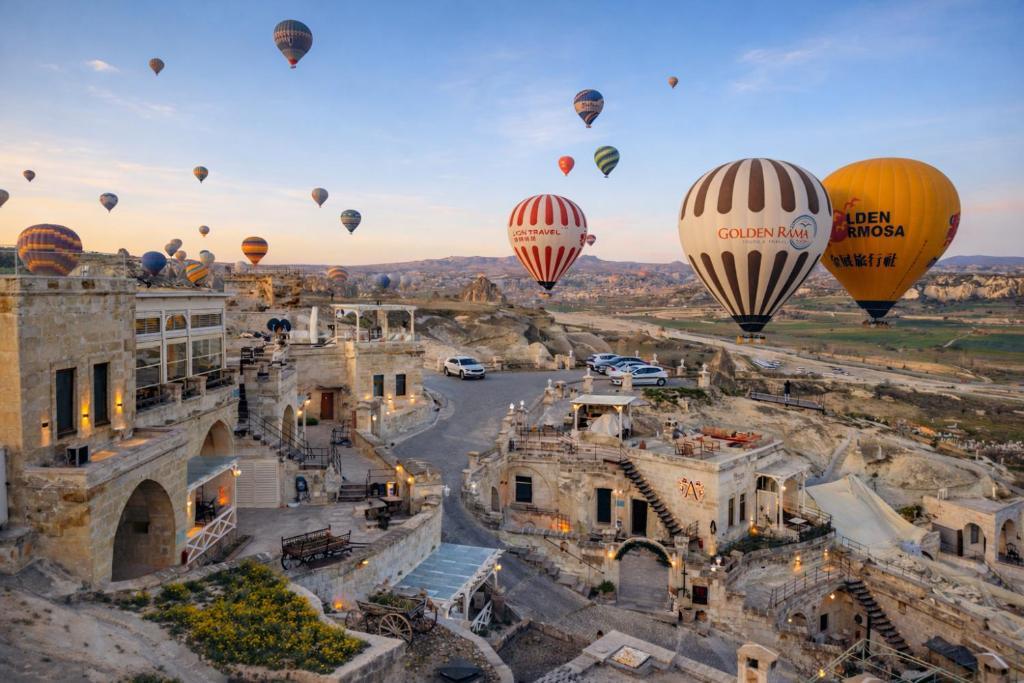
Guests wake up in rooms that feel like part of the landscape itself—curved ceilings, stone floors, and windows that open onto valleys where hot air balloons drift at sunrise.
Hot air balloons at dawn
Few experiences match watching Cappadocia from a hot air balloon at sunrise.
Flights typically begin before dawn, when the winds are calmest. As the balloon rises, the landscape below reveals itself in layers: patchwork fields, cave dwellings tucked into hillsides, winding riverbeds, and the fairy chimneys standing like sentinels across the valleys.
The balloons drift silently over the terrain, carried by the wind. Passengers see the region from a perspective that is impossible from the ground—a bird’s-eye view of a landscape shaped by both geology and human history.
Underground cities and cave churches
Beneath Cappadocia’s surface lie entire underground cities.
Derinkuyu and Kaymaklı are the best known, extending multiple levels below ground with ventilation shafts, wells, kitchens, living quarters, and communal spaces. These cities were used as refuges during periods of invasion and persecution, capable of sheltering thousands of people and their livestock.
Above ground, the region’s cave churches preserve some of the finest examples of Byzantine art. The churches of Göreme Open Air Museum feature frescoes painted directly onto the rock walls, depicting biblical scenes in colors that have survived for centuries.
Planning your visit
The best time to visit Cappadocia is spring (April to June) or autumn (September to November), when temperatures are mild and the skies are clear.
Hot air balloon flights operate year-round, weather permitting, with early morning being the preferred time. Cave hotels range from budget-friendly to luxury, and booking in advance is recommended—especially during peak seasons.
Getting to Cappadocia is straightforward. The region is served by Nevşehir Kapadokya Airport (NAV) and Kayseri Erkilet Airport (ASR), with flights from Istanbul and other Turkish cities.
A destination that stays with you
Cappadocia is a place where the boundaries between nature and culture blur.
The landscape was shaped by volcanic fire and glacial time. The human history is carved into the same rock. And the experience—waking in a cave room, watching balloons rise at dawn, descending into an underground city—is one that lingers long after you leave.
For travelers seeking a destination that feels unlike anywhere else on Earth, Cappadocia delivers.
Sources and Further Reading
- UNESCO World Heritage Centre — Göreme National Park and the Rock Sites of Cappadocia.
- Türkiye Ministry of Culture and Tourism — Cappadocia Travel Guide.
- Göreme National Park — Visitor information and park regulations.
Editorial note: Hot air balloon flights are weather-dependent and may be canceled if conditions are not safe. Underground city visits involve stairs and confined spaces; visitors with mobility concerns should plan accordingly.