
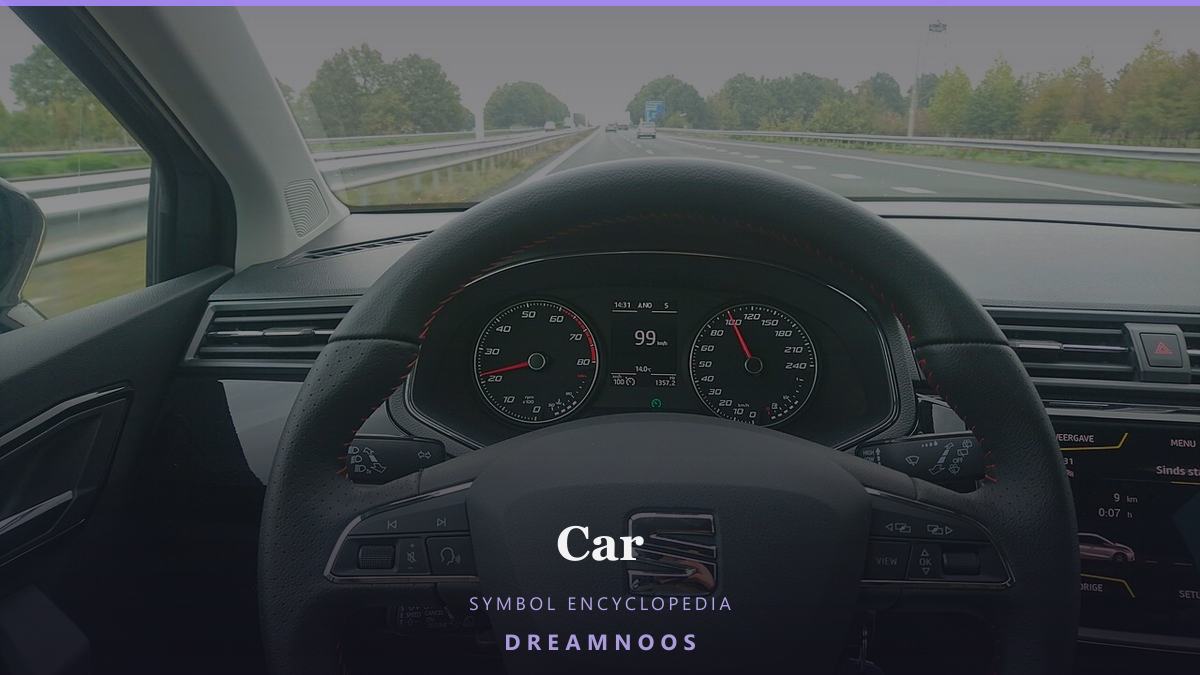
Car
Car symbolism in dreams — agency, direction, status, control, and who holds the wheel of your life.
The car is the twentieth century’s default metaphor for self-directed motion — you choose lane, speed, destination, or surrender the wheel. Dreams exploit that grammar relentlessly: brake failure, wrong turns, stolen keys, backseat driving.
Classical layers
Agency and path. Driver seat = authorship of life direction. Passenger = delegation, dependency, or trust.
Status and persona. Luxury car vs broken-down vehicle maps self-image and resource anxiety — not bank balance prophecy.
Risk and collision. Accidents dramatize feared impact — argument, firing, betrayal — before it happens in daylight.
Escape. High-speed flight from threat merges chase with vehicle symbolism.
Reading checklist
Who drives? Known destination? Mechanical failure or external crash? Interior condition? Who else is in the car?
Hub note
Vehicle-tagged library dreams below refine scene grammar. Pair career when work commute dominates.
Cross-links
Chariot tarot, Aries resonance. Why car dreams.
Journal prompt
Am I driving, riding, or watching my life pass from the sidewalk?
Cars ask who steers — and whether you trust the road ahead.
Direction, control, and who is driving
The car is the dominant modern dream image for a life in motion under the dreamer’s own management. Unlike the train, which runs on rails laid by others, and unlike the plane, which commits irreversibly at takeoff, a car can turn, stop, reverse, and choose its route. That freedom is the whole point of the symbol, and the readings turn on how much of it the dreamer actually has.
Driving well is unremarkable enough that it rarely produces a memorable dream. What produces dreams is failure of control, and it arrives in a small number of consistent forms.
Brakes that do not work. Among the most frequently reported dream scenarios of any kind. The dreamer presses and the pedal sinks, or the car slows insufficiently, or not at all. This corresponds to situations in which a process has acquired momentum the dreamer cannot check — commitments accumulating, a pace of work that cannot be reduced, a relationship or plan moving faster than they intended.
Being a passenger in your own life. Dreams in which someone else drives — a parent, a partner, an employer, or nobody identifiable — read as agency ceded. Who is at the wheel is usually the most informative detail in the dream.
The back seat, or no driver at all. The variant in which the dreamer finds themselves in the rear of a moving car, or discovers the driver’s seat is empty, is a distinct and unsettling scenario. It tends to accompany periods in which a life is proceeding on established momentum without anyone actively steering it.
Losing the car. Forgetting where it is parked, or having it stolen, reads as loss of the means of direction rather than of the direction itself — resources, health, or independence that enabled the dreamer to go where they chose.
Condition and terrain
The state of the vehicle reports on the dreamer’s resources. Cars that are damaged, out of fuel, or breaking down accompany periods of depletion with unusual directness — dreamers frequently recognise the correspondence without needing it interpreted.
The road matters equally. Familiar routes, unknown roads, dead ends, roads that narrow or deteriorate, and roads under fog each frame the same journey differently, and the terrain usually names the conditions rather than the destination.
How to read a car-coded dream
1. Who is driving? The primary question in the entire symbol.
2. Do the controls respond? Brakes, steering, and acceleration each fail in dreams, and each failure names a different loss of agency.
3. What is the car’s condition? Vehicle health maps onto the dreamer’s own resources.
4. Where is the road going? Known or unknown destination, and whether the route is one the dreamer chose.
5. Who else is in the car? Passengers introduce responsibility for others travelling on the dreamer’s decisions.
Crashes and what they are not
Collision dreams are common and are routinely feared to be predictive. The interpretive tradition does not read them that way. A crash is the point at which a direction the dreamer was travelling meets something that stops it — and in waking life that is usually a plan meeting a constraint, not a vehicle meeting another vehicle.
What discriminates these dreams is fault and aftermath. Crashes the dreamer causes tend to accompany situations where they suspect their own choices are heading somewhere bad. Crashes caused by others accompany situations where an outside force has interrupted a course the dreamer was managing adequately. And dreams that continue past the impact — walking away, surveying damage, finding oneself unhurt — often carry the more useful material in what follows rather than in the collision itself.
What this hub aggregates
The DreamNoos car hub collects dream topics turning on cars and driving — including brake failure, crashes, being a passenger, empty driver’s seats, stolen and lost cars, and dreams of driving roads the dreamer does not recognise. Sideways it points to train for journeys on fixed routes, plane for irreversible departures, and the fear theme where loss of control dominates.
Real-world reference: Car on Wikipedia — for the literal, non-symbolic background on car.
Explore Car beyond dreams
This symbol hub covers dream interpretation. You can also explore car through tarot, astrology, and angel numbers — reflective lenses, not competing truths.
Related tarot cards
Related zodiac signs
Angel numbers
Describe your dream in the interpreter — try keywords like car driving vehicle crash
Dreams featuring car
- Buying a Big Car in a Dream Buying a Big Car in a Dream: what this dream usually means — magnitude layered over car symbolism, with psychological and classical readings.
- Big Car in a Dream Big Car dreams show car appears at enlarged scale—symbol and transition under big, with witness, rescue, or release scenes.
- Buying a Black Car in a Dream Buying a Black Car in a Dream: what this dream usually means — the unknown layered over car symbolism, with psychological and classical readings.
- Buying a Blue Car in a Dream Buying a Blue Car in a Dream: what this dream usually means — distance and calm layered over car symbolism, with psychological and classical readings.
- Blue Car in a Dream Blue Car dreams show car holds cool distance tone—symbol and transition under blue, with witness, rescue, or release scenes.
- Broken Car in a Dream Broken Car dreams show car fractures without ending—symbol and transition under broken, with witness, rescue, or release scenes.
- Burning Car in a Dream Burning Car dreams show car consumes in crisis—symbol and transition under burning, with witness, rescue, or release scenes.
- Buying a Clean Car in a Dream Buying a Clean Car in a Dream: what this dream usually means — order and integrity layered over car symbolism, with psychological and classical readings.
- Clean Car in a Dream Clean Car dreams show car shows purified reset—symbol and transition under clean, with witness, rescue, or release scenes.
- Crying While Buying a Car in a Dream Crying While Buying a Car in a Dream: what this dream usually means — grief surfacing layered over car symbolism, with psychological and classical readings.
- Buying a Dead Person's Car in a Dream Buying a Dead Person's Car in a Dream: what this dream usually means — finality layered over car symbolism, with psychological and classical readings.
- Dead Car in a Dream Dead-car dreams stall your drive—mobility ended, independence parked for good, journey interrupted, or the vehicle of self that will no longer start.
- Buying a Dirty Car in a Dream Buying a Dirty Car in a Dream: what this dream usually means — contamination layered over car symbolism, with psychological and classical readings.
- Dying Car in a Dream Dying Car dreams show car fades in process—symbol and transition under dying, with witness, rescue, or release scenes.
- Falling Car in a Dream Falling Car dreams show car drops from height—symbol and transition under falling, with witness, rescue, or release scenes.
- Buying a Flying Car in a Dream Buying a Flying Car in a Dream: what this dream usually means — escape and perspective layered over car symbolism, with psychological and classical readings.
- Buying a Golden Car in a Dream Buying a Golden Car in a Dream: what this dream usually means — idealisation layered over car symbolism, with psychological and classical readings.
- Golden Car in a Dream Golden Car dreams show car shines as valued ideal—symbol and transition under golden, with witness, rescue, or release scenes.
- Buying a Green Car in a Dream Buying a Green Car in a Dream: what this dream usually means — growth and renewal layered over car symbolism, with psychological and classical readings.
- Green Car in a Dream Green Car dreams show car carries living growth tone—symbol and transition under green, with witness, rescue, or release scenes.
- Buying a Car and Losing It in a Dream Buying a Car and Losing It in a Dream: what this dream usually means — disorientation layered over car symbolism, with psychological and classical readings.
- Buying a Car While Pregnant in a Dream Buying a Car While Pregnant in a Dream: what this dream usually means — potential forming layered over car symbolism, with psychological and classical readings.
- Pregnant Car in a Dream Pregnant Car dreams show car swells before release—symbol and transition under pregnant, with witness, rescue, or release scenes.
- Buying a Red Car in a Dream Buying a Red Car in a Dream: what this dream usually means — urgency layered over car symbolism, with psychological and classical readings.
- Buying a Car in a Hurry in a Dream Buying a Car in a Hurry in a Dream: what this dream usually means — momentum layered over car symbolism, with psychological and classical readings.
- Running Car in a Dream Running Car dreams show car moves under pressure—symbol and transition under running, with witness, rescue, or release scenes.
- Buying a Silver Car in a Dream Buying a Silver Car in a Dream: what this dream usually means — quiet value layered over car symbolism, with psychological and classical readings.
- Silver Car in a Dream Silver Car dreams show car reflects as secondary tone—symbol and transition under silver, with witness, rescue, or release scenes.
- Buying a Small Car in a Dream Buying a Small Car in a Dream: what this dream usually means — reduction layered over car symbolism, with psychological and classical readings.
- Small Car in a Dream Small Car dreams show car appears at reduced scale—symbol and transition under small, with witness, rescue, or release scenes.
- Buying a White Car in a Dream Buying a White Car in a Dream: what this dream usually means — clarity and exposure layered over car symbolism, with psychological and classical readings.
- Buying a Yellow Car in a Dream Buying a Yellow Car in a Dream: what this dream usually means — caution layered over car symbolism, with psychological and classical readings.
- Yellow Car in a Dream Yellow Car dreams show car glows with bright caution—symbol and transition under yellow, with witness, rescue, or release scenes.
- Buying a Car in a Dream An interpretation of car-purchase dreams focused on autonomy, status anxiety, long-term commitment, and the psychology of 'choosing a direction.'
- Car in a Dream A complete interpretation of car dreams centered on direction, control, speed, and life-trajectory management.
- Car Accident in a Dream Car accident dream meaning — usually loss of control over life direction, not a traffic omen. Direct answers for brake failure, witness dreams, spiritual reads, and surviving a crash.
Share Your Dream Experience
Had a similar dream? Share your experience or ask a question — comments appear after moderation.
No comments yet. Be the first to share your experience.