A Year on Simulated Mars: What 378 Days in Isolation Revealed About Human Spaceflight
Four volunteers spent 378 days inside NASA's simulated Mars habitat. Their experience reveals the human challenges of isolation, teamwork and life beyond Earth.
A Year on Simulated Mars: What 378 Days in Isolation Revealed About Human Spaceflight
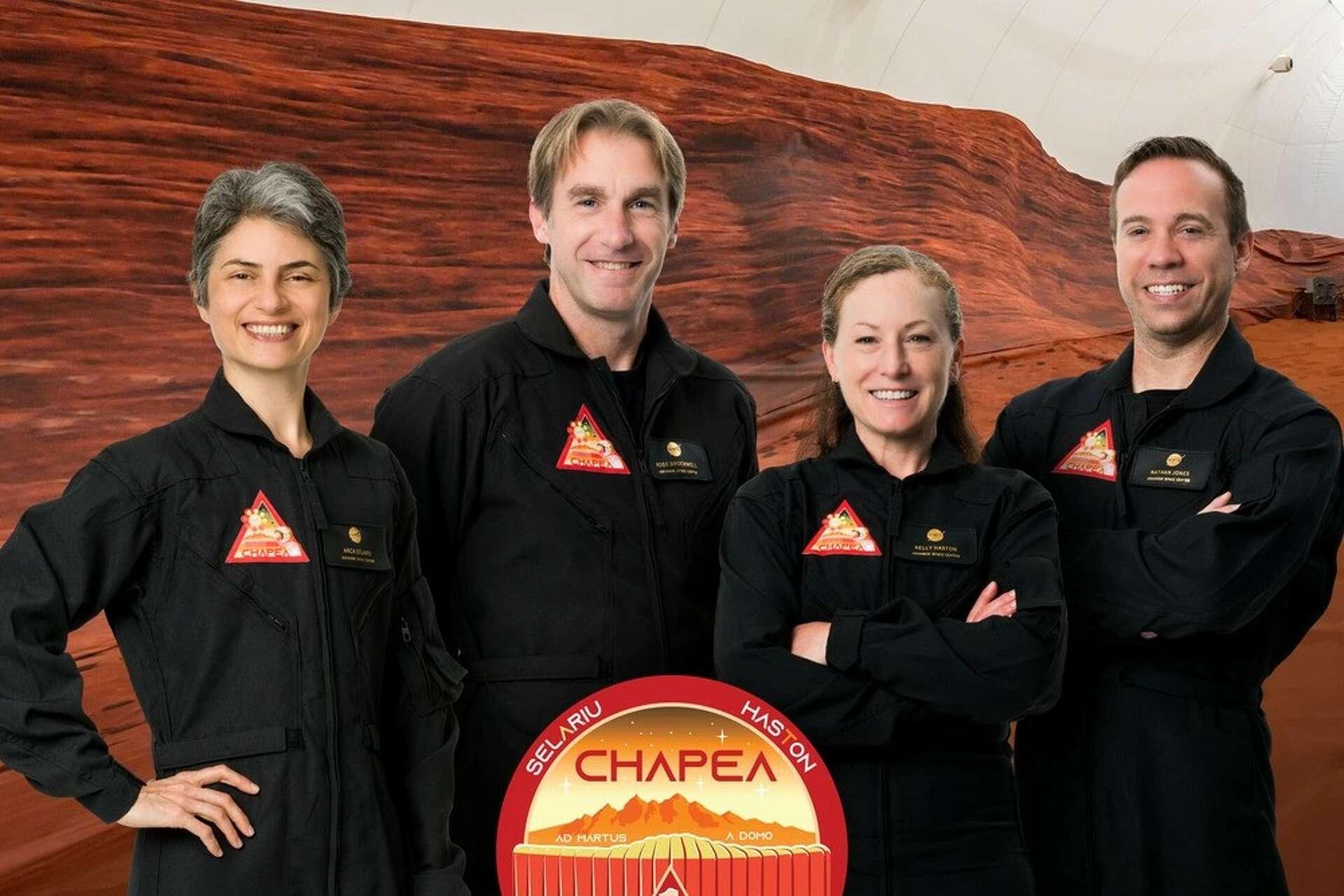
Four volunteers have returned from a year inside a simulated Martian habitat. Their experience offers a rare look at the routines, relationships and practical challenges that could shape humanity’s future beyond Earth.
On October 31, 2026, four people stepped out of a building at NASA’s Johnson Space Center in Houston after spending 378 days inside a habitat designed to imitate life on Mars.
They had not traveled to another planet. They had not experienced Martian gravity, breathed its atmosphere or stood beneath its unfamiliar sky. Yet their year inside NASA’s Mars Dune Alpha habitat was designed to confront a different kind of reality: what happens to people when ordinary life is replaced by isolation, limited resources, delayed communication and the responsibility of depending on a small team.
The participants were Ross Elder, Ellen Ellis, Matthew Montgomery and James Spicer. They formed the second crew of NASA’s Crew Health and Performance Exploration Analog, known as CHAPEA.
Their return marked the end of an unusually long experiment in human behavior and operational readiness. The questions it raises extend well beyond space exploration. How do people maintain relationships in confined environments? What happens when help is never immediately available? And how much of a successful mission depends on the everyday routines that keep a team functioning?
A year inside a carefully controlled world
The CHAPEA Mission 2 crew entered the habitat on October 19, 2025. The structure, measuring approximately 1,700 square feet, was built using 3D-printing technology and designed to reproduce selected conditions of a future Mars surface mission.
Inside, the crew lived and worked according to a demanding schedule. Their responsibilities included scientific experiments, habitat maintenance, physical exercise, simulated spacewalks and crop cultivation.
The environment was deliberately restrictive. Supplies were limited, activities had to be planned, and the participants could not simply step outside whenever they wanted.
The habitat also reproduced communication delays. Depending on the simulated distance between Earth and Mars, messages could take between 13 and 22 minutes to arrive. This changed the nature of ordinary communication. A question could not always receive an immediate answer, and a problem could not necessarily be passed to mission control for instant guidance.
The experiment was not intended to recreate every physical condition of Mars. Instead, it focused on understanding how people might live and perform over an extended period when resources, communication and personal freedom are constrained.
NASA’s human research teams will use the information gathered during the mission to study crew health, performance and the demands of future exploration.
Matthew Montgomery’s work: growing food and studying rocks
Among the four participants, science officer Matthew Montgomery had responsibilities that connected two important parts of a potential Mars expedition: food production and geological research.
Montgomery brought experience in electrical engineering and controlled-environment agriculture. During the simulation, he helped oversee the cultivation of crops, including leafy greens, peppers and tomatoes.
Growing plants in a confined habitat is more than a convenient way to add fresh food to a menu. It represents a practical challenge for long-duration missions. A crew traveling far from Earth cannot depend on frequent resupply shipments. Food systems must be efficient, reliable and capable of operating with limited resources.
Plants may also contribute to the psychological environment. Caring for living things can introduce variety and a sense of continuity into a setting otherwise dominated by machinery, schedules and repetitive tasks.
The crew also carried out geological exercises. They examined rock samples, identified minerals and simulated aspects of the analysis that future explorers might perform on the Martian surface.
These activities were designed to reproduce parts of scientific work that could take place during a real mission. The participants were not simply occupying a model spacecraft environment; they were expected to complete tasks while managing the pressures of living together for more than a year.
The two-week silence
One of the most demanding parts of the experiment was a planned two-week communication blackout.
On a real Mars expedition, communication with Earth could be interrupted when the Sun obstructs the direct radio path between the two planets. Such a period would leave astronauts without their normal connection to mission control.
The CHAPEA crew prepared for this scenario for approximately a month. They reviewed procedures, established schedules, agreed on objectives and made plans for situations that might require action without outside assistance.
For two weeks, they operated without contact with mission control or the outside world.
The significance of the exercise was not simply that the crew could tolerate silence. It was that they had to continue functioning responsibly when an external team could not provide immediate direction.
This is a fundamental difference between living on Earth and working on a distant planet. On Earth, a difficult situation can often be escalated to someone with more experience, additional equipment or greater authority. On Mars, a crew may have to assess the problem, decide what matters most and act with the resources already available.
The simulation offered NASA an opportunity to examine how preparation, procedures and team autonomy might support that responsibility.
Teamwork began before the mission
A year in a confined habitat can place unusual pressure on personal relationships. Even small disagreements may become difficult when the same people share work, meals, recreation and living space every day.
The crew therefore spent considerable time building relationships before entering the habitat. Their preparation included five weeks of pre-mission training and a winter camping expedition in Wyoming, where they encountered a blizzard.
These experiences helped the participants understand how one another responded to uncomfortable and demanding situations before the longer simulation began.
In an interview with Nature, Montgomery described the crew’s working relationship as positive, with very little conflict. That observation is important, although it should not be mistaken for proof that every long-duration crew will experience the same outcome.
A four-person team is a small social system. Personality differences, fatigue, workload and unexpected problems can all influence its stability. A successful mission therefore requires more than selecting people with strong technical qualifications. It also requires preparing them to communicate, resolve disagreements and recognize when another team member needs support.
The CHAPEA experience provides a real-world environment in which NASA can examine these factors, rather than relying exclusively on short training exercises.
Why ordinary routines matter in space
The most revealing aspects of a long-duration mission may not always be dramatic.
A meal, a workout, a conversation, a maintenance task or a few minutes spent caring for plants can become important parts of a crew’s daily structure.
On Earth, people rarely think about how much their routines depend on variety and access to the outside world. A change of scenery, an unexpected visit or a short journey can break up a repetitive day. In a confined habitat, those opportunities are sharply reduced.
The CHAPEA participants had to create a functional daily life within a limited environment. Exercise supported physical conditioning. Crop cultivation provided practical work and contact with living plants. Scientific tasks gave the crew shared objectives. Maintenance helped preserve the habitat on which their safety depended.
These activities were not interchangeable. Each served a different purpose, and together they helped make the simulated environment operationally meaningful.
The experiment also highlights why future spaceflight planning cannot focus exclusively on rockets, propulsion and landing systems. A habitat must support people over time, not merely keep them alive.
Food systems, exercise equipment, medical planning, work schedules and communication protocols are all part of the architecture of a human mission.
What NASA can learn from the experiment
CHAPEA is part of a broader effort to understand the risks associated with long-duration human spaceflight.
NASA’s research teams will examine the health and performance information collected during the mission. Areas of interest include how the crew adapted to the environment, how physical demands affected their work, and how the systems inside the habitat supported daily operations.
The data may help researchers refine approaches to food production, exercise, medical support, communication and crew autonomy.
However, the limits of the experiment matter.
The participants lived in Houston, not on Mars. They were not exposed to the planet’s radiation environment, reduced gravity, toxic surface dust or the full consequences of a real interplanetary journey. A simulated habitat cannot reproduce every physical, psychological and operational risk of a mission millions of kilometres from Earth.
Nor does the completion of one mission establish that a particular crew structure or habitat design is ready for Mars.
CHAPEA is an analog research programme. Its value lies in testing selected conditions, observing human performance and identifying questions that require further investigation.
The findings must be considered alongside other research, engineering tests and future analog missions.
The distance between a simulation and Mars
There is something unusual about the crew’s return. After more than a year of restricted movement and delayed communication, the participants emerged into a world that had continued changing without them.
Their experience was not a journey through space, but it was a demanding test of how people might adapt to a future in which distance changes almost every aspect of daily life.
For NASA, the next challenge is to translate observations from a controlled environment into practical decisions about future missions. A crew traveling to Mars will need dependable technology, but it will also need systems that allow people to work, rest, eat, exercise, solve problems and maintain a sense of connection.
The first human explorers of Mars will not spend their days thinking only about the planet’s scientific mysteries. They will also have to manage equipment failures, limited supplies, repetitive schedules and the ordinary demands of living with other people.
That is what makes the 378-day experiment relevant. It reminds us that reaching another world is only one part of human exploration.
The harder question may be whether we can build a life there.
Sources and Further Reading
- NASA — NASA’s Simulated Mars Crew Marks One Year Inside Habitat (October 19, 2026).
- NASA — NASA Invites Media to Crew Completion of Yearlong Mars Simulation (October 27, 2026).
- Nature — He spent a year on ‘Mars’: NASA science officer emerges from mock mission (November 9, 2026).
- Reuters — Crew from NASA’s simulated Mars mission emerges after 378 days in isolation (November 1, 2026).
- University of Central Florida — UCF Alum ‘Returns to Earth’ After 378-Day Mars Mission (October 27, 2026).
Editorial note: This article distinguishes NASA’s simulated mission from an actual spaceflight. The mission’s final health and performance findings should not be treated as published conclusions until NASA releases and evaluates the relevant data.