
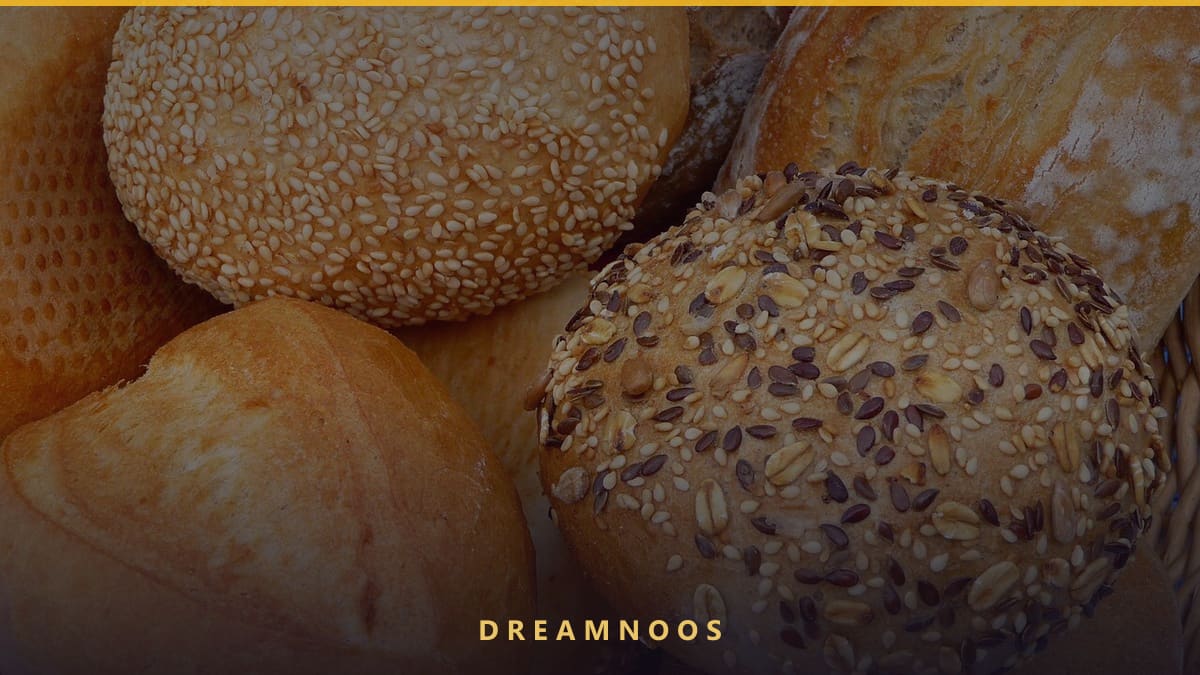
What a bread dream means
Bread dreams are nourishment dreams. They usually reflect how stable, meaningful, and sufficient the dreamer’s daily support system feels.
Classical readings of bread dreams
Classical traditions frequently connect bread with provision, lawful earning, and social blessing. Quality and sharing context strongly shape meaning.
Bread symbolism
- Fresh bread -> active provision and renewal.
- Dry bread -> constrained resources or low satisfaction.
- Shared bread -> relational trust and reciprocity.
- Burned bread -> overstrain in effort cycles.
The psychology of bread dreams
Psychological readings treat bread imagery as a core-security indicator: “Do I feel fed, safe, and sustained?”
How context changes a bread dream
- Baking bread: building support from effort.
- Buying bread: exchange-based security.
- No bread available: scarcity perception.
Positive/negative interpretation conditions
Positive lane strengthens when bread is warm, enough, and peacefully consumed. Cautionary lane strengthens with rot, conflict over food, or repeated searching.
Common bread dream scenarios
- Eating bread at a table.
- Baking bread in an oven.
- Carrying bread home.
- Finding stale bread.
Non-obvious interpretive insights
- Bread texture often maps emotional quality of support.
- Repeated undercooked-bread scenes can signal unfinished preparation.
- Too much bread may indicate hoarding anxiety, not abundance.
- Shared crust vs center can symbolize fairness concerns.
- Burned edges often map overcontrol in routine.
- Hidden bread can reflect fear of dependence.
- Table atmosphere matters more than quantity.
- Bread with silence can indicate unmet relational nourishment.
Emotional branching
- Bread + gratitude -> integrated provision and trust.
- Bread + fear -> scarcity vigilance.
- Bread + relief -> recovery from instability.
- Bread + shame -> perceived inadequacy in providing.
High-intent variants (micro-intent map)
- Eating bread dream meaning.
- Baking bread dream meaning.
- Burned bread dream meaning.
- Stale bread dream meaning.
- Buying bread dream meaning.
- Sharing bread dream meaning.
Comparative cultural lens
- Islamic lens: halal provision, blessing, and livelihood ethics.
- Jungian lens: psychic nourishment and grounding.
- Christian lens: sustenance, gratitude, and communion motifs.
- Persian domestic lens: table culture and household stability.
Observed recurring patterns
- Recurring stale-bread dreams often appear during prolonged dissatisfaction cycles.
- Repeated bread-baking scenes commonly track renewed self-sufficiency efforts.
- Sharing-bread motifs frequently emerge when relational trust is rebuilding.
Common co-occurring symbols
- Bread + table: relational nourishment quality.
- Bread + oven/fire: effort intensity and timing.
- Bread + home: household stability and daily structure.
Interpretive contradictions
- Bread abundance is not always positive; it can reflect anxiety-driven accumulation.
- Bread scarcity is not always negative; it may trigger realistic reprioritization.
Source-anchored notes
- Classical sources repeatedly treat staple foods as provision and ethics symbols.
- Modern interpretations emphasize security perception and routine sustainability.
Entity psychology — bread
Nourishment — bread as food maps sustenance, comfort, or deprivation themes. Taboo and pleasure — Forbidden bread vs shared meal tilts guilt vs joy. Preparation — Raw, cooked, spoiled bread tracks process vs outcome anxiety. Social table — Alone or with others eating bread marks belonging. Body intake — Swallowing or rejecting bread mirrors boundary with desire. Season and storage — Fresh vs stored bread hints timing of need.
Traits to track: daily sustenance, shared table, basic security.
What bread represents in dreams
- Core bread symbol — Your waking associations to bread anchor the read before any glossary.
- Setting layer — Home, travel, work, or nature calibrates tone and scale.
- Your role — Witness, cause, rescuer, or fugitive shifts agency.
- Emotion on waking — Fear, grief, relief, or shame tilts integration vs avoidance.
- Vs cluster links — Compare related hub pages in your graph—not interchangeable symbols.
Extended psychological read
Food dreams of Bread often track diet change, fasting, feast, or family meal tension. Bread in a Dream is less about nutrition facts than emotional intake—accepting or rejecting bread in scene.
Bread dreams across cultures and traditions
Food taboo, feast, and famine imagery runs through religious fasting traditions and harvest rites; personal diet, culture, and table memory anchor the symbol.
More bread dream scenarios
Feast of bread. Abundance or excess—joy vs guilt.
You choke on bread. Too much too fast—overwhelm metaphor.
Hungry for bread. Need not met waking—deprivation theme.
Spoiled bread. Missed window or guilt about waste.
Bread as gift. Received nourishment—who offered?
Planting or harvesting bread. Patience and season—timing read.
Bread tastes wrong. Disgust or betrayal of expectation.
Forbidden bread. Taboo pleasure or rule conflict.
Bread in childhood kitchen. Memory anchor—nostalgia or wound.
Cooking bread. Preparation for change—process before outcome.
Negative signals vs positive signals
| Signal type | Scene cue | Read |
|---|---|---|
| Strain | Panic, no action | Anxiety loop on bread |
| Strain | Stranger bread, no context | Archetype overload |
| Repair | Care or rescue acted | Agency after {attr} |
| Repair | Calm after naming feeling | Integration arc |
How to read your bread dream
- Name the setting — Where bread appeared and who watched.
- Your action — Did you tend, flee, fix, or only observe bread?
- Waking emotion — Fear, grief, relief, or shame on waking.
- Recent bread link — Media, conversation, or memory this week.
- One line journal — What {attr} changed about bread in scene.
More bread dream questions
Vs similar symbols? Bread psychology differs from swap-in entities—use cluster contrasts.
Childhood memory of bread? Personal history outweighs generic omen lists.
Nightmare vs curious dream? Waking emotion calibrates threat, not dictionary alone.
Recurring bread? Track one waking theme per week—pattern over single night.
What your bread dream is telling you
Name one role you played, one emotion on waking, and one waking link to bread. Revisit cluster pages when bread repeats—integration beats prophecy spiral.
Snippet-oriented recap
Bread dreams map daily sustenance, shared table, basic security through scene context. Link related hub entries—not fixed omen gloss alone.
Share Your Dream Experience
Had a similar dream? Share your experience or ask a question — comments appear after moderation.
No comments yet. Be the first to share your experience.