Living Colors: How Biology Is Changing the Future of Textile Design
From plant pigments to living microorganisms, new research is changing how designers create textile colors and rethink sustainable fashion.
Living Colors: How Biology Is Changing the Future of Textile Design
Imagine a shirt whose colour comes from microorganisms rather than a conventional synthetic dye. Picture a fabric printed with pigments extracted from agricultural waste, or a textile whose appearance changes when exposed to a different level of acidity.
These ideas may sound experimental, but they are increasingly part of scientific research into the future of materials and design.
For centuries, people have used plants, minerals and other natural sources to colour clothing. Industrial chemistry transformed that practice, making it possible to produce consistent shades at enormous scale. Today, researchers are exploring whether biology can offer another way forward.
The emerging field combines textile engineering, microbiology, chemistry and design. Its ambition is not simply to bring traditional natural dyes back into fashion. It is to rethink how colour is produced, how it interacts with materials and what happens to the substances used in manufacturing.
Research published throughout 2026 illustrates how quickly this area is developing. Scientists are studying plant pigments with unusual colour-changing properties, microbial systems that can produce colour during textile processing, and methods for making natural dyes work more effectively on modern fibres.
The result is a new design question: what if colour itself became a biological material?
The hidden chemistry behind the colours we wear
Colour is one of the most visible characteristics of clothing, yet the process that creates it is often invisible to consumers.
Most modern textiles are coloured using synthetic dyes and pigments. These substances are designed to provide specific shades, predictable performance and compatibility with industrial manufacturing systems.
Synthetic colourants have made modern fashion possible at enormous scale. They can produce consistent colours across large batches, support complex patterns and work with different fibres.
But conventional textile dyeing can also involve substantial water consumption, heat, chemical auxiliaries and wastewater treatment.
The environmental impact depends on the dye, fibre, factory technology, process conditions and effectiveness of wastewater management. It would be inaccurate to assume that every synthetic dye has the same environmental profile or that every natural dye is automatically harmless.
Still, the industry faces a clear challenge: finding ways to produce colour while reducing unnecessary resource use and environmental damage.
Natural colourants are attracting renewed attention because they offer a different starting point.
Plants, fungi, microorganisms and agricultural by-products can contain molecules that absorb and reflect light in ways that create visible colour.
Examples include:
- Indigo-producing plants, associated with deep blue shades
- Madder roots, historically used for red and reddish tones
- Turmeric, which contains the yellow pigment curcumin
- Pomegranate peels, which contain tannin-rich compounds
- Butterfly pea flowers, known for their blue anthocyanin pigments
- Certain bacteria and fungi, which produce coloured biological molecules
These sources are not interchangeable. Their chemical composition, stability, availability and compatibility with fibres can differ significantly.
The challenge is turning interesting pigments into reliable materials for everyday products.
From traditional dye plants to scientific material design
Natural dyeing is not a new invention.
Across Asia, Africa, Europe and the Americas, communities developed sophisticated techniques for extracting colour from plants and other natural materials.
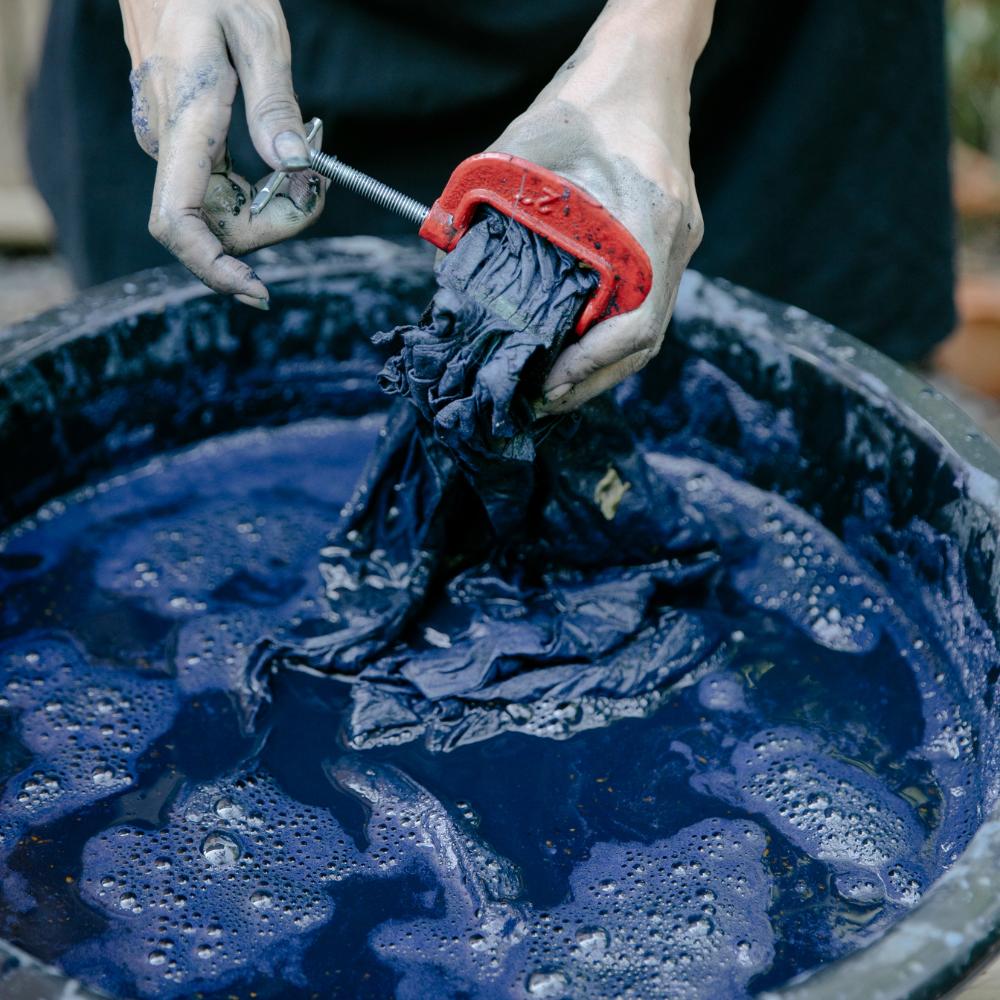
Indigo dyeing, for example, became an important part of textile traditions in many regions. Different cultures developed their own methods of preparing dye vats, treating fibres and creating patterns.
These techniques were not simply decorative. They reflected local agriculture, trade, craftsmanship and accumulated knowledge about materials.
Modern research is revisiting this heritage with analytical tools that earlier generations did not possess.
Spectroscopy can identify how pigments absorb light. Chromatography can help separate and characterise chemical compounds. Microscopy can reveal how dyes interact with the surface of fibres.
The aim is to understand why some natural colours remain stable while others fade quickly, and how processing conditions can improve performance.
This scientific approach also reveals why natural dyeing is more complicated than extracting a colourful liquid and applying it to fabric.
A pigment must interact with a particular fibre. Cotton, wool, silk and regenerated cellulose materials have different chemical and physical properties. A dye that performs well on one material may produce weak or unstable results on another.
Designers therefore need to think about the entire material system rather than the pigment alone.
The blue flower that could make colour responsive
One particularly interesting development appeared in November 2026.
Researchers investigated natural dye extracted from Clitoria ternatea, commonly known as butterfly pea.
The flower is recognised for its vivid blue colour, which can shift towards purple or reddish tones depending on acidity.
The effect is associated with anthocyanins, a family of naturally occurring pigments found in many flowers, fruits and vegetables.
In the November 8 study published in Fashion and Textiles, researchers examined the extract using several analytical methods, including ultraviolet-visible spectroscopy and chemical analysis, before testing it on textile materials.
The results showed clear pH-dependent changes in the pigment’s optical behaviour.
The researchers also found that cotton demonstrated particularly strong dye uptake among the tested fibre materials.
This is interesting for more than its visual effect.
A material that changes colour in response to its chemical environment could potentially be used in responsive textiles, educational materials or simple visual indicators.
For example, future textile applications might explore fabrics that indicate exposure to certain chemical conditions through a visible colour change.
However, the research is still at an experimental stage.
The authors identified limitations involving dye fixation, durability and long-term stability. A pigment that changes colour beautifully in a laboratory solution is not necessarily ready for repeated washing, sunlight exposure and everyday wear.
The difference between a promising material and a commercial textile product can be substantial.
Can microorganisms actually dye fabric?
Perhaps the most unconventional development is the use of living microorganisms in textile coloration.
Microorganisms such as bacteria and fungi can produce pigments as part of their biological processes.
Scientists have investigated these compounds as potential alternatives to conventional colourants. But an even more ambitious approach involves using living microbial cultures directly during textile processing.
A 2026 primer by Ivana Malagurski and Tatjana Ilic-Tomic, published in Biotechnology for the Environment, explores this concept.
The authors describe how microbial metabolism can generate coloured compounds under relatively mild processing conditions.
In certain approaches, fermentation and textile coloration can occur together.
This is different from simply producing a pigment in a laboratory, extracting it and then using it like a conventional dye.
The biological process itself becomes part of the manufacturing method.
Potential advantages include reduced reliance on some high-temperature processes and certain chemical auxiliaries. Depending on the microorganism and production system, microbial coloration may also offer opportunities to work with renewable feedstocks.
But the technology has important practical questions to resolve.
Which microorganisms produce pigments reliably? How can production be scaled? What happens to the organisms after processing? Can the colour survive washing, sunlight and friction? How can manufacturers maintain consistent results across large batches?
These are not minor details.
Textile production operates under demanding commercial conditions. A process must be repeatable, safe, cost-effective and compatible with existing manufacturing equipment.
The biological origin of a pigment alone does not guarantee that the final process will be sustainable.
Turning food waste into textile colour
Another promising direction is the use of agricultural and food-processing by-products.
Large quantities of plant material are generated during food production. Some of this material contains valuable compounds that could potentially be recovered.
Fruit peels, leaves, roots and other plant residues may contain pigments, tannins and other substances with useful chemical properties.
Researchers are investigating whether these materials can become inputs for textile coloration.
A June 2026 study in Scientific Reports examined prickly pear peel waste as a source of natural dye for wool.
The researchers investigated conventional and microwave-assisted processing methods, including their effects on dyeing time, colour strength and fabric performance.
The work demonstrates how a material commonly treated as agricultural waste can be investigated as a potential textile resource.
But there is an important distinction between using waste and creating a genuinely circular production system.
Agricultural residues are not automatically impact-free. They must be collected, transported, processed and stored. Extraction can require energy, water and additional chemicals.
If a dye process needs large quantities of a by-product that is available only seasonally or in limited locations, scaling it up may create new supply-chain pressures.
The strongest opportunities may come from local systems in which agricultural residues are available close to textile manufacturers and processing methods are adapted to the materials at hand.
This is where design, manufacturing and regional resource planning begin to overlap.
Why natural does not always mean sustainable
The growing interest in natural dyes is understandable, but the term “natural” can create misleading expectations.
A plant-based pigment may be biodegradable, yet its cultivation could require substantial land or irrigation.
A dye extracted from agricultural waste may still require intensive processing.
Some natural dyes need mordants: substances used to help the colour bind to the fibre. Certain traditional mordants involve metal salts that require careful handling and wastewater management.
Colour durability is another issue.
If a fabric fades quickly and must be replaced sooner, the environmental benefits of its original dye may be reduced.
The full environmental performance of a textile depends on several interconnected factors:
Raw material sourcing: Where does the pigment come from, and what resources are required to produce it?
Extraction: How much water, energy and chemical input are needed to obtain the colour?
Dye application: What temperatures, processing times and auxiliaries are required?
Performance: Does the colour remain stable during washing, sunlight exposure and normal use?
End of life: Can the textile and its colourants be safely recycled, reused or biodegraded?
A review published in the European Journal of Futures Research on July 31, 2026, examined the role of natural textile colourants in wider sustainability transformation.
The authors argued that natural dyes have potential to challenge established industrial practices, but they also identified barriers involving cost, availability, consumer expectations and the dominance of existing synthetic systems.
That is an important perspective.
Replacing one ingredient does not automatically transform an entire industry. Sustainable design requires attention to production systems, consumer habits and the infrastructure surrounding materials.
A Turkish connection: Textile research beyond traditional craft
Türkiye has a particularly relevant position in this discussion.
The country has a substantial textile and apparel manufacturing sector, alongside academic institutions working on textile chemistry, engineering and design.
Research published in Textiles on September 3, 2026, by researchers associated with Bursa UludaÄŸ University and industry partners examined the use of ozone treatment to improve natural dye uptake in Tencel fabrics.
The researchers tested madder and barberry root dyes on fabric samples treated with ozone under different conditions.
Their findings showed improved dye uptake and colour strength under selected experimental conditions.
The study also examined fabric properties and colour fastness, rather than measuring colour intensity alone.
This is important because natural dye research needs to move beyond attractive sample photographs.
For manufacturers, the practical questions are whether a colour can be reproduced, whether it remains stable, how the fabric performs after processing and whether the method can be integrated into existing production lines.
The involvement of university researchers and industrial partners also illustrates the importance of collaboration.
Designers may identify the desired visual qualities. Chemists can investigate pigment behaviour. Textile engineers can evaluate fibre compatibility and processing. Manufacturers can determine whether a method works at production scale.
The next generation of textile innovation is likely to emerge from these overlapping disciplines.
What could biological colour mean for fashion design?
The most exciting possibility is that designers may eventually have access to a wider range of materials with properties that go beyond conventional colour.
Consider three potential directions.
Responsive textiles
Pigments that change their optical behaviour in response to pH, temperature or other environmental conditions could inspire responsive textile surfaces.
Some applications might involve visual indicators or interactive design.
These concepts remain dependent on material stability, safety and the ability to control the response under real-world conditions.
Locally sourced colour systems
Designers could work with regionally available plants, agricultural residues or microbial production systems.
This might encourage closer connections between textile manufacturing, agriculture and local craft traditions.
It could also create new design identities based on regional materials rather than globally standardised colour palettes.
Materials designed around biological processes
Microbial pigments may eventually allow manufacturers to reconsider parts of the dyeing process itself.
Rather than treating colour as a separate chemical input, some production methods could incorporate biological activity into material manufacturing.
This is a broader shift from simply designing the appearance of a product to designing the process that creates it.
The concept is closely related to biodesign, a field in which biological systems become active participants in the development of materials, products and environments.
The commercial challenge: Can living colour compete?
Scientific potential does not automatically translate into market success.
The fashion industry depends on speed, cost control, predictable supply and consistent quality.
A major clothing manufacturer may need thousands of metres of fabric in precisely the same shade. A designer working with a small batch of hand-dyed material can tolerate variations that would be difficult to accept in mass production.
Natural colour systems therefore face several commercial challenges.
First, supply can be inconsistent. Pigment composition may vary with plant variety, growing conditions, harvest time and extraction methods.
Second, performance must meet the requirements of the intended product. Clothing, upholstery, sportswear and outdoor fabrics experience very different conditions.
Third, manufacturers must demonstrate that alternative methods offer meaningful environmental advantages rather than simply replacing one resource-intensive process with another.
Finally, consumer expectations matter. A naturally dyed textile may have subtle variations that are part of its character. Some buyers will appreciate this individuality, while others will expect perfectly uniform colour.
The market may not need one universal solution.
Biological colour systems could first become valuable in specialist fashion, limited collections, premium textiles, interior design or products where material origin and craftsmanship are part of the appeal.
Over time, improvements in extraction, formulation and production control may expand the range of possible applications.
A different way to think about colour
For much of the modern industrial era, colour has been treated as a predictable property added to a finished material.
Biological approaches suggest another possibility.
Colour can be produced by living organisms, extracted from renewable materials, influenced by environmental conditions or integrated into the development of a textile itself.
This does not mean that synthetic dyes will disappear, or that natural pigments will become the universal answer to textile pollution.
Both approaches have strengths and limitations. The important question is how each material and process performs in a specific application.
What makes this field worth watching is the change in perspective.
Designers are no longer limited to choosing a colour from a catalogue. They can increasingly explore the chemistry, biology and origin of the colour itself.
The next major innovation in fashion may not be a new silhouette or fabric texture. It may be a different relationship between living systems and the materials people wear.
And perhaps the most interesting future colours will not simply be manufactured. They will be grown.
Sources and Further Reading
- Perera, H. A. A. et al. (2026). Natural dye from Clitoria ternatea and its halochromic behavior. Fashion and Textiles. Published November 8, 2026.
- Malagurski, I. & Ilic-Tomic, T. (2026). Biological and sustainable textile coloration with live microorganisms. Biotechnology for the Environment. Published August 3, 2026.
- Virta, L., Fernström, P. & Räisänen, R. (2026). Colours within planetary boundaries? Applying the Three Horizons framework to a critical review of natural dyes in the textile industry sustainability transformation. European Journal of Futures Research. Published July 31, 2026.
- Özenç, A. A., Eren, S. & Atlas, Z. (2026). Improving Natural Dye Uptake in Tencel Fabrics Through Ozone Treatment. Textiles. Published September 3, 2026.
- El Gabry, L. K., Abdelhafez, T. F. & Hakeim, O. A. (2026). Up cycling prickly pear peel waste for sustainable wool dyeing using microwave irradiation. Scientific Reports. Published June 8, 2026.
- UNESCO " Traditional craftsmanship and textile heritage.
Editorial note: Natural and microbial colouration technologies remain at different stages of research and commercial development. Potential environmental advantages depend on the complete production process, material performance and end-of-life conditions.