Can Historic Buildings Warn Us Before Their Walls Begin to Deteriorate?
Researchers are combining AI, environmental sensors and 3D imaging to identify early signs of deterioration in historic buildings.
Can Historic Buildings Warn Us Before Their Walls Begin to Deteriorate?
For centuries, the condition of a historic building has largely been assessed through periodic inspections. Conservators examine walls, photograph visible damage, measure moisture where possible and decide which areas need attention. It is a process built on experience and careful observation, but it has one unavoidable limitation: deterioration may already be underway by the time it becomes obvious.
A growing area of architectural conservation is exploring whether that process can become more anticipatory. Instead of waiting for visible damage, researchers are combining environmental sensors, three-dimensional imaging and machine learning to identify patterns associated with early deterioration.
A study published in Scientific Reports in November 2026 offers a detailed example of this approach. Conducted across three heritage sites in Semarang, Indonesia, the research brings together continuous environmental monitoring and artificial intelligence to assess changes on historic building façades.
The work does not mean that an algorithm can independently decide when a monument needs restoration. Its more significant contribution is a practical demonstration of how environmental information and visual analysis can be combined to help conservation teams identify areas that deserve closer attention.
Why historic buildings are difficult to monitor
Historic buildings rarely deteriorate in a uniform way. A wall exposed to heavy rainfall may experience very different conditions from an interior surface protected from direct weather. Roof edges, shaded courtyards, poorly ventilated rooms and areas close to the ground can all develop their own microclimates.
Humidity is particularly important in tropical environments. Persistent moisture can encourage biological growth, contribute to staining and interact with salts within porous construction materials. Temperature changes, rainfall, ventilation and the physical characteristics of masonry can influence how these processes develop.
The visible signs are not always straightforward. A darkened patch might indicate moisture, biological activity, accumulated dirt or a combination of factors. A change in surface colour does not automatically establish structural damage.
This is why conservation specialists rely on more than photographs. They consider the building’s materials, construction history, environmental exposure and previous interventions before deciding what a visible change means.
The challenge is to collect enough information to understand how these conditions vary across a building and how they change over time.
A research project across three heritage sites in Indonesia
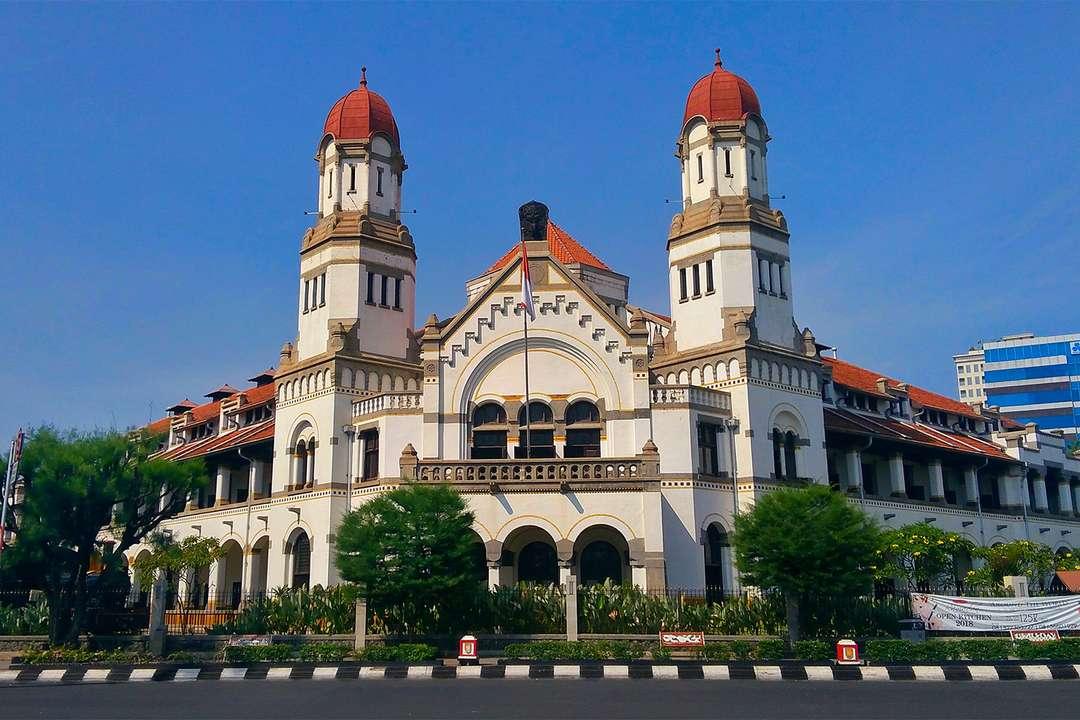
The 2026 study examined three historic locations in Semarang: Lawang Sewu, Pasar Johar and Tawang Railway Station.
These buildings provide different architectural and environmental contexts for examining façade deterioration. Rather than treating each structure as a single surface, the researchers combined environmental monitoring with detailed visual information.
The project ran for 14 months and used a hybrid artificial intelligence and Internet of Things framework. Environmental sensors collected information such as temperature and relative humidity, while photogrammetric three-dimensional models provided detailed visual data about building surfaces.
The researchers then used machine-learning methods to identify and classify patterns associated with different forms of chromatic deterioration.
The study’s approach is notable because it does not rely on images alone. Environmental measurements were incorporated into the predictive workflow, allowing the model to consider conditions surrounding the observed surface patterns.
That distinction matters. A visual classification system might identify a discoloured area, but environmental information can help explain why that area deserves attention.
How artificial intelligence interprets changes in building surfaces
The research combined several computational techniques rather than relying on a single image-recognition model.
First, the researchers used colour information in the HSV colour space " hue, saturation and value " to identify groups of visually similar surface patterns. Hierarchical clustering helped organise these patterns before supervised classification was applied.
A Random Forest model was then used to classify the resulting data. This machine-learning method combines multiple decision trees to produce a classification outcome.
The framework also incorporated a derived measure called the Humidity Stress Factor, or HSF. Rather than treating humidity as a simple snapshot, the researchers used accumulated environmental exposure as an input to the classification process.
This is an important design choice. A brief period of high humidity and repeated exposure over an extended period are not necessarily equivalent for a porous historic surface.
The researchers also used three-dimensional photogrammetric information to preserve the spatial relationship between observed surface patterns and the building façade.
In practical terms, the goal is not simply to label a photograph. It is to connect visual changes with their location and the environmental conditions under which they occur.
What the researchers found
The study reported a pixel-level classification accuracy of 91.2% and a macro-F1 score of 0.87, based on 48,686 expert-labelled pixels.
These figures indicate that the framework performed well in distinguishing the labelled surface categories within the research dataset. They should not, however, be interpreted as a 91.2% guarantee that an entire historic building can be diagnosed correctly.
One of the study’s most important findings concerned the Humidity Stress Factor. Including this environmental measure increased macro-F1 by 9.2 percentage points compared with the relevant model configuration without it.
The researchers also reported a strong association between cumulative exposure to relative humidity above 85% and deterioration measurements, with a Spearman correlation coefficient of 0.82.
This does not establish that humidity alone caused every observed surface change. It does, however, support the importance of environmental monitoring when assessing tropical heritage façades.
The research also tested whether the framework could work across different locations. Leave-one-site-out validation produced F1 scores between 0.79 and 0.82, suggesting that the model retained useful classification performance when evaluated on a site excluded from the corresponding training process.
That is an encouraging result, although three sites in one city are not enough to demonstrate universal performance across different climates, materials and architectural traditions.
Could a building provide an early warning?
Perhaps the most interesting part of the research is its examination of potential warning times.
The researchers conducted retrospective testing to estimate how early the system could identify conditions associated with high-risk events. The analysis reported conditional technical lead-time estimates of:
- 4.8 hours for a six-hour horizon.
- 9.2 hours for a twelve-hour horizon.
- 16.7 hours for a twenty-four-hour horizon.
These estimates require careful interpretation. They are technical lead times calculated from retrospective test data, not proof that a conservation team will always receive a reliable warning that many hours in advance.
The study also accounted for missed events. After this adjustment, the corresponding expected estimates were lower: 3.8, 7.3 and 13.2 hours.
That distinction is essential. A system that identifies some developing risks early but misses others cannot replace routine inspections or professional judgement.
Nevertheless, even a limited warning window could be useful in certain situations. A conservation team might use it to prioritise an inspection, review environmental readings or investigate a section of a building that has shown unusual changes.
The value lies in providing another source of evidence, not in making the final conservation decision automatically.
What this could mean for the future of architectural conservation
The wider significance of this research is its potential to change how historic buildings are monitored.
Traditional conservation often depends on scheduled inspections and the availability of experienced specialists. Those methods remain essential, but they can be difficult to apply continuously across large or complex heritage sites.
A sensor-based system could provide a more detailed picture of environmental exposure between inspections. Three-dimensional documentation could help conservators compare the same areas over time. Machine-learning analysis could then help identify changes that deserve further examination.
There are several possible applications.
Prioritising inspections: Buildings with limited conservation budgets could use monitoring data to identify areas requiring closer attention.
Documenting gradual change: Repeated imaging and environmental measurements could create a record of how surfaces respond to seasonal conditions.
Supporting restoration planning: Conservation specialists could combine historical records, material assessments and monitoring results when deciding where to direct resources.
Improving environmental management: If persistent humidity is associated with particular areas of deterioration, teams could investigate ventilation, drainage or other building-management measures.
These applications are possibilities rather than outcomes already demonstrated at scale. They would require suitable monitoring infrastructure, reliable data, trained staff and clear procedures for responding to alerts.
The limitations that still matter
The research is a promising technical demonstration, but it also highlights why predictive conservation should be approached carefully.
First, the framework was evaluated at three sites in Semarang. Historic buildings elsewhere may have different construction materials, surface treatments, climates and maintenance histories. A model developed in a tropical coastal environment should not be assumed to perform equally well in a dry climate or a cold European winter.
Second, the classification process depends on expert-labelled data. Machine learning can identify patterns, but the meaning of a particular colour cluster still requires interpretation. Biological patina, moisture staining and salt deposits can sometimes appear similar in photographs.
Third, the early-warning estimates came from retrospective analysis. A live deployment would introduce additional challenges, including sensor failures, data gaps, changing environmental conditions and the time required for staff to respond.
Finally, detecting surface deterioration is not the same as diagnosing structural safety. A model that identifies a suspicious façade pattern cannot independently determine whether a wall is structurally sound or whether a building is safe to occupy.
These distinctions are important because historic buildings are not ordinary data problems. They are complex physical structures with cultural, architectural and social significance.
A more informed way to protect historic places
The future of heritage conservation is unlikely to be a choice between traditional expertise and artificial intelligence.
Experienced conservators understand materials, construction methods and the historical significance of individual structures. Digital monitoring systems can add another layer of evidence by recording environmental conditions and identifying patterns that might otherwise be difficult to track.
The Semarang study demonstrates how those capabilities can be brought together. Its strongest contribution is not the suggestion that AI can replace conservators, but the evidence that continuous environmental sensing can improve the interpretation of visual deterioration data.
As the technology develops, the most useful systems may be those that remain transparent about uncertainty, work alongside established inspection practices and help specialists decide where their attention is needed most.
A historic building cannot explain what is happening inside its walls. But with better monitoring, its changing surfaces and surrounding environment may provide earlier clues " giving the people responsible for protecting it more time to investigate.
Research source
Gbran, H., Rukayah, S., Suprapti, A., Setyowati, E. and Setiawan, I. (2026). “A hybrid AI-IoT framework for predictive conservation of tropical heritage façades: empirical validation from a multi-site study in Indonesia.” Scientific Reports.
https://doi.org/10.1038/s41598-026-74267-z
Editorial note: The findings and performance figures in this article refer to the published research and its stated validation methods. Technical lead-time estimates should not be interpreted as operational guarantees.
Suggested image: Lawang Sewu building exterior.
- Photographer: Sellamaria
- License: CC0 1.0 " free for commercial use.
- Source page: Wikimedia Commons " Lawang Sewu
- Select the high-resolution original file when downloading.
Primary research source: Scientific Reports " A hybrid AI-IoT framework for predictive conservation of tropical heritage façades. Study published online 5 November 2026. The study’s results, validation methods and limitations form the basis of this article. Nature+1